THE CONNECTOR: How a Chicago Broker Became One of America’s Most Influential Forces in Distressed‑Market Redevelopment
THE CONNECTOR: How a Chicago Broker Became One of America’s Most Influential Forces in Distressed‑Market Redevelopment
CHICAGO - For more than three decades, Terri Cox has been the quiet force behind some of the most improbable commercial transformations in Chicago. In neighborhoods where national brokers rarely walk the blocks, Cox has spent her career listening to residents, studying the rhythms of daily life, and building retail ecosystems that reflect the people who live there. She is not simply a broker. She is a connector, a strategist, a community steward, and one of the most accomplished retail dealmakers in the country.
Her awards alone tell a story—multiple CoStar Power Broker Awards, four consecutive Crexi Platinum Broker Awards placing her in the top one percent of brokers nationwide, and Developer of the Year honors for major Chicago redevelopment projects. But the accolades only hint at the scale of her influence. Cox’s work is visible in the plazas she rebuilt, the corridors she stabilized, the tenants she attracted, and the communities she helped revive. Her career is a map of Chicago’s most overlooked neighborhoods, each one marked by a project she refused to give up on.
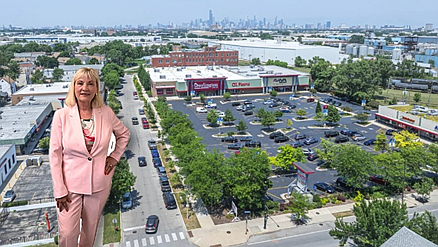
Bishop Plaza, at 1422 W. 47th St., is the clearest example. When Cox first stepped into the Back of the Yards property more than 30 years ago, it was a small, partially vacant strip center with only a few tenants and no clear future. “Initially, when I started with the development, we only owned the small shopping center,” she recalled. “Jewel‑Osco owned the large parcel, and when they closed, it sat vacant for years.” She led the acquisition, fought restrictive covenants, and even lobbied City Hall to remove a grocery‑store limitation that blocked redevelopment. She chased Marshalls “around the shopping center convention for four years” until she finally secured them. She rebuilt the plaza again and again as retail trends shifted, ultimately landing Burlington, CSL Plasma, UI Health, and Aviva Wholesale. What began as a struggling strip center became a 96‑percent‑leased, 76,000‑square‑foot anchor of the neighborhood.
When it came time to sell, national brokerage firms told Matanky Realty Group the property would trade at a 10 percent cap rate. Cox disagreed. “I told the owners, give me the listing. I know I can do better.” She sold it at a 7.8 cap, delivering millions more in value than the national firm projected. The final sale price was $11.5 million, a number that underscores just how dramatically she elevated the value of a center she had spent three decades shaping. Her approach was not magic—it was mastery. “Understanding how many people actually come there, shop there, live there, work there,” she said. “That’s what makes the difference.”
Her understanding of people comes from years of standing in their grocery aisles, walking their blocks, listening to their frustrations, and earning their trust — a knowledge built not from reports or data sets, but from the lived texture of the communities she serves. Cox has served for years as a commissioner on Chicago’s Special Service Areas, directing funds for safety, scholarships, youth programs, and community improvements. “We make improvements for the streetscape… we support the ballet for kids… we provide security for the retail and industrial areas,” she said. She has also spent the last fifteen years as Mrs. Claus in Back of the Yards, riding on a fire truck through the neighborhood, handing out gifts to children, and creating the only family photos many children receive all year. “I’ve watched these little kids grow up,” she said. “It’s very fulfilling.”
Her influence extends far beyond Chicago’s city limits. In the Southland, Cox has become one of the most important voices in redevelopment, particularly in communities that have not seen major investment in decades. She has brought Teddy’s Fresh Market, Hair Sauce, DTLR, Rainbow, Subway, and dozens of national and local tenants to Hazel Crest, Olympia Fields, Park Forest, Dolton, and other suburbs. She understands the incentives that make development possible—Class 8 tax reductions, workforce development programs, empowerment zones, opportunity zones—and she knows how to assemble the right partners to unlock them. “There’s a lot of available buildings and land in the Southland,” she said. “And people who need goods and services. This is about bringing everybody together so they can see what’s possible.”
Her work in Harvey may be the most consequential of all. Once a manufacturing hub, Harvey suffered a collapse after industry left the region. Cox has been one of the few brokers willing to take on the challenge of rebuilding it. She brought Castle Car Wash, the first major new retail investment in Harvey in fifty years, and she has assembled the tenants, incentives, and vision for a ten‑acre redevelopment that could become the Southland’s most important commercial project in decades.
It was Cox who convinced developer Kyle Garner, founder of E&S Development, to invest in Harvey. They met at the ICSC national retail convention in Las Vegas in May 2025, where Cox approached him with what he now calls one of the clearest development pitches he had ever heard. “She approached me with this subject matter expert knowledge,” Garner said. “She talked about the ten‑acre site, who was already there, the traffic count, why it was attractive. She had the seller. She had interested tenants. She just needed a developer.”
Garner said her credibility and relationships were decisive. “She knows all the major retailers and she’s respected in the industry. She understands what communities need and knows how to leverage her relationships to fill those voids.” When he visited Harvey, everything Cox described was exactly as she said. “We weren’t being trailblazers—we were following the blaze,” he said. “She made it very plain and clear why this would be a mutually beneficial development.”
Cox recently co‑hosted the Southland Franchise Expo and Economic Development Conference at Governors State University, drawing more than one hundred businesses and organizations interested in expanding into the region. Her mission is consistent: identify the voids, bring the right players together, and make development possible where others have failed.
Her day‑to‑day schedule reflects the intensity of her commitment. She trains salespeople, meets with tenants, negotiates leases, reviews properties, and works with municipalities on incentives. She often works past midnight and starts again at dawn. “I’m busier now than I’ve ever been,” she said. “I’m not a person who can retire.”
She is candid about the challenges facing retail—online shopping, warehousing replacing manufacturing, retail theft, safety concerns—but she has adapted at every turn. She implemented 24‑hour security at centers in high‑crime areas. She studies national retail trends. She tracks demographic shifts. And she remains skeptical that artificial intelligence will replace brokers in communities like Harvey or Back of the Yards. “AI can’t replace understanding people,” she said. “If you treat people respectfully and honestly, and if you learn your craft so you’re an expert, people will come to you.”
With the sale of Bishop Plaza, Cox’s 30‑year vision for one of Chicago’s most challenging retail corridors has come full circle. But she is far from done. She is still brokering deals, still rebuilding communities, still mentoring young brokers, still serving as Mrs. Claus, still fighting for Harvey, Back of the Yards, and every neighborhood that needs a champion.
Her story is not just about real estate. It is about commitment, community, and the belief that underserved neighborhoods deserve the same quality of retail, safety, and investment as any other part of America. For thirty years, Terri Cox has been the one making that happen—and if you ask the people who know her best, she is just getting started.
Latest Stories
- Bally’s Chicago Marks Three Years with $30,000 in Donations to Local Nonprofits
- The public is invited to celebrate the grand reopening of the newly renovated Malcolm X College West Campus and Danny K. Davis Community Center
- While Black Families Pay More for Power, Some Attorneys General Fight to Save High-Cost Coal
- Rotary Clubs Unite for the World’s Largest Polio Walk on World Polio Day
- The Inner Circle acknowledges Asia Alexus Alexander as a Pinnacle Professional of The Year
Latest Podcast
Memories of being a Preachers Kid