University of Chicago Host Speakers to Discuss Black Women and State Violence
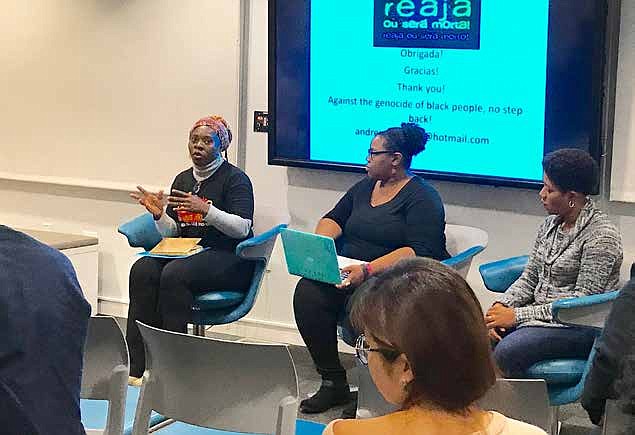
University of Chicago Host Speakers to Discuss Black Women and State Violence
By: Katherine Newman
The University of Chicago hosted Andreia Beatriz dos Santos and Christen Anne Smith on Nov. 15 to speak on the topic of black women, state violence, and the transnational struggle for black lives. The discussion was mediated by PhD student Alyssa Mann Carey.
Andreia Beatriz dos Santos is a medical doctor at the Lemos Brito prison in Salvador, Brazil. She is the co-founder of the React or Die Campaign (Reaja ou Será morta), and a PhD candidate at the Federal University of Bahia where she studies the impact of
the prison system on families and prisoners health.
Christen Anne Smith, Ph. D. is a black feminist anthropologist, social justice advocate, and Associate professor of Anthropology and African and African Diaspora Studies at The University of Texas at Austin.
She has worked with dos Santos and been a member of Reaja since 2005.
The two women traveled to The University of Chicago to challenge students to re-examine the way they understand anti-black violence.
“If you are African you are part of a collective. You are part of a people. You are part of a group,” said dos Santos.
Today, in Brazil, black men are more often than not the target of unwarranted police violence, according to dos Santos. She described the police as being “the most important instrument that the state uses against black people.”
She also pointed to another issue, not only are black men being killed and sent to prison at an alarming rate, the impact that these events have on black women, who might be the mother, wife, or sister of these black men, is equally as devastating.
“We have the increase of black young men being killed, we have a big problem. We are not just talking about when this group is being killed we are talking about the impact of the death of black young,” said dos Santos.
At this point the discussion shifted over to the topic that Smith was there to speak on, the way we view anti-black police violence is gendered.
The way that data is analyzed is very linear and doesn’t represent the the dimensions of anti-black violence, according to Smith.
“We rely almost exclusively on counting the bodies, quite literally. We quantify black death and in that process of quantification we have a very narrow concept of time.”
We talk about the black men that are victims of anti-black policing, but never discuss the way that black women can be effected, according to Smith.
“The body count is always going to give us more black men but if we move away from body count and we think about the reverberating and lingering effects of black death,” Smith said. “I would argue the disproportionate targets of anti-black policing are actually black women.”
Both Smith and dos Santos believe if the state is responsible for killing a black man the state is also responsible for the effects that death has on that persons family and friends.
In conjunction with that thought, Smith concluded that anti-black violence is not nationally or culturally specific in the way that it is often talked about and by acknowledging this and breaking away from the numerical data that goes along with antiblack violence it is possible to make black women across the world visible in ways they have never been before.
Latest Stories
- HIP-HOP LEGENDS SCARFACE, TOO SHORT AND DO OR DIE ARE COMING TO HARD ROCK LIVE NOV 20
- Good Soil Forum Returns to Award $500,000 to Entrepreneurs and Founders Ready for Growth
- Lisa Price, Tokyo Stylez, Olamide Olowe, Cornell McBride Sr. and More to Be Honored at 2026 Bronner Bros. Beauty Icon Awards
- CHICAGO RESIDENTS WANT QUANTUM
- CCA ACADEMY BECOMES PART OF THE SOLUTION TO A NEIGHBORHOOD'S FOOD-ACCESS PROBLEM
Latest Podcast
An Educator School Closure Prospective