Legislation Aims To Provide Equitable Funding To Public Universities
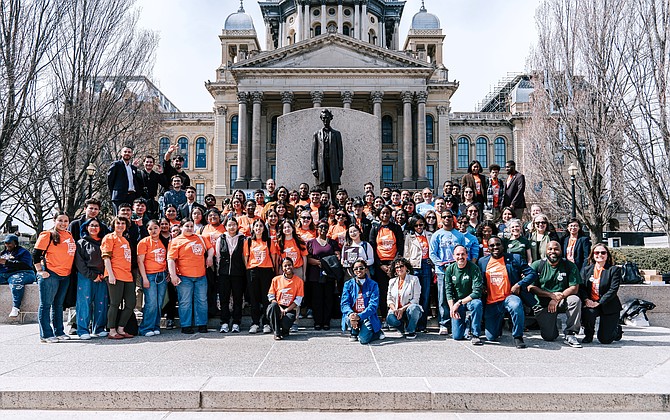
Legislation Aims To Provide Equitable Funding To Public Universities
By Tia Carol Jones
Legislation currently in the Illinois House seeks to make funding public universities more equitable. Illinois Senate Bill 813/Illinois House Bill 1581, The Adequate and Equitable Public University Funding Act, would make the Illinois Board of Higher Education responsible for distributing all general operating expenses for public universities using a statewide funding formula. The legislation was introduced by Illinois State Senator Kimberly Lightford and Illinois State Representative Carol Ammons.
Chicago State University President Zaldwaynaka “Z” Scott, said currently there is no formula for how the state of Illinois appropriates funding to the state’s public universities. She said that each of the state’s public universities are serving different student populations in different regions of the state. She said that HB1581 would allow proper investment, as well as fair investment, in all of the students and faculty, and all of the learning facilities, in a way that would be fair and equitable.
“We need to prioritize, in this strategy, sustaining our public universities, and providing appropriate support for the students that each university serves and moving them from the time that they are with us, to a college degree,” Scott said. She said it would mean that programs would have additional support for scholarships, basic needs assistance, and give the institutions a boost in the appearance of the campuses.
Scott said that not having a formula makes the funding uneven amongst the public universities. In Chicago State’s case, it serves the highest percentage of student parents in the state of Illinois, has the highest percentage of PELL grant recipients in the state and a number of the school’s students come from 0under resourced high schools. She said those things impact enrollment and retention and need to be taken into consideration when it comes to funding Chicago State and the other public universities across the state of Illinois.
The Coalition for Transforming Higher Education Funding believes that the funding model should be student-driven and student centered, prioritizing equity to drive transformation in access and opportunity, cultivate a healthy, diverse and stable higher education system, and adequately fund institutions to meet diverse student needs. Eyob Villa-Moges is a Senior Policy Advisor for Advance Illinois, which works toward a more equitable and high-quality education and care system for all Illinois students.
The statewide advocacy and education policy research organization is part of the Coalition for Transforming Higher Education Funding. Villa-Moges said HB1581 would create a new funding approach to funding public universities in the state of Illinois, based on sustainability, equity, adequacy and accountability. He said the current funding model for public universities is tied to politics and financial constraints of Springfield, instead of the number of students at an institution or the needs of the students at those institutions.
“In flush years, when Springfield has additional resources, universities will see an across the board increase; every institution will get three percent. When it is tighter in Springfield, you will get an across the board decrease,” Villa-Moges explained. He added that in the last 20 years, funding for public universities has significantly decreased and funding has dropped more than 40 percent.
Villa-Moges said the decrease in funding for public universities has created financial hardships for students and their families. He said the new funding model bases funding on the student population, the demographics of the institution, the programs the institution offers and how much the institution needs in order to effectively support students so they can enroll, persist and graduate at a high rate. He said that the funding formula proposed in the legislation would amend for the history of underfunding public universities in Illinois.
“This bill would create the budgetary relief that institutions need so that they could lower tuition and fees,” he said. Villa-Moges said if they don’t lower tuition fees, they could increase dramatically, which would result in more financial strain on the high needs students who might have fewer resources.
Scott said that she is hopeful that HB 1581 will be passed. She said the work started three years ago to bring forth this legislation. She said the presidents of the public universities, along with other civic leaders, were at the table working through data, looking at the students and the institutions, and coming up with a strategy for equitable funding. She said it is an equitable, data-driven approach to provide equitable funding to sustain the state’s public universities.
“All of our public universities contribute to the economic impact of our state. It’s time for our state to invest in our public universities and invest in our students,” Scott said.
For more information about Chicago State University, visit http://www.csu.edu. For more information about the Coalition for Transforming Higher Education Funding, visit https://transformhigheredil.org.
Latest Stories
- Rotary Clubs Unite for the World’s Largest Polio Walk on World Polio Day
- The Inner Circle acknowledges Asia Alexus Alexander as a Pinnacle Professional of The Year
- Illinois DCFS, IDPH and Safe Kids Illinois partner with public transit agencies across Illinois to promote Infant Safe Sleep Awareness Month
- Main Stage Improv Brings Halloween Comedy Spooktacular to Tinley Park
- University of Chicago Medicine to expand in Northwest Indiana with 43,500-square-foot medical care facility in Valparaiso
Latest Podcast
Learning To Live Life Correctly By Knowing Your Blood Type